
Container numbers: what they mean and why some boxes look different
Date:
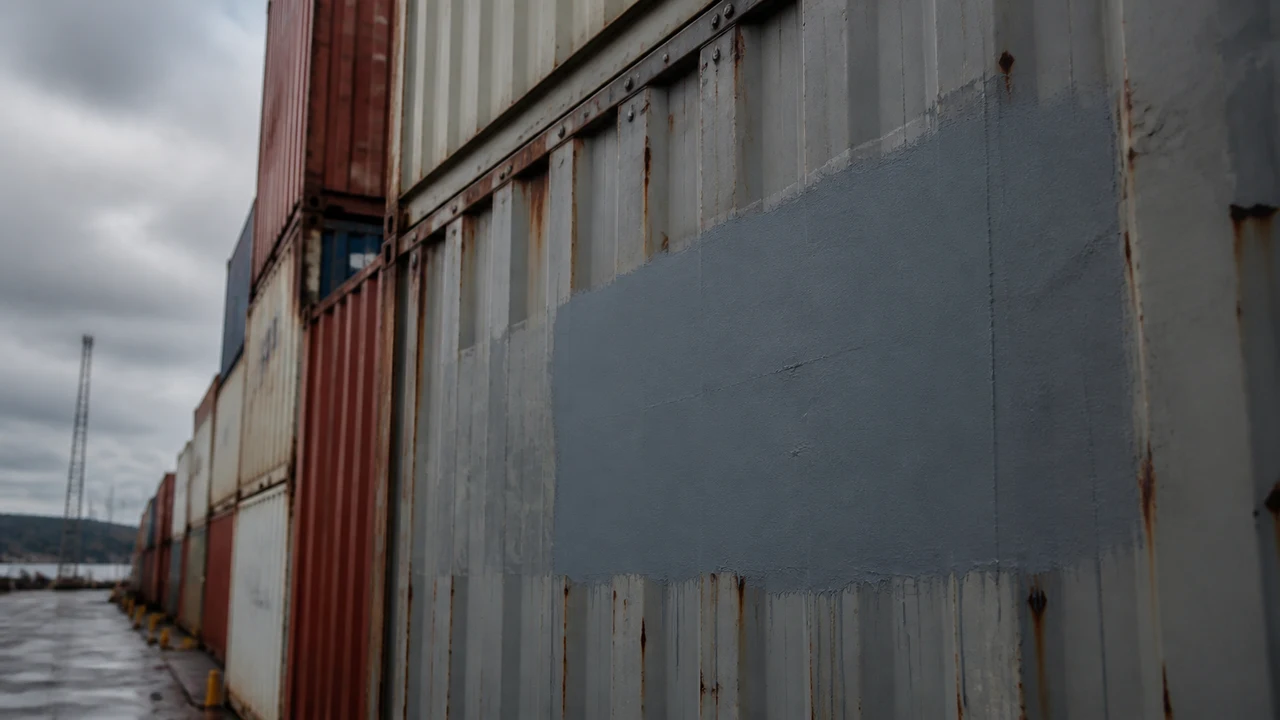
Why one container carries a shipping line's logo and full number, another has its prefix painted over, and a third bears completely different letters. A plain explanation of container neutralisation — and how to verify a prefix in the BIC register.
Containers standing side by side in the same yard can look surprisingly different. One carries a shipping line’s logo and a complete number, another has part of its number painted over, and a third shows different letters than it left the factory with. All three are perfectly normal. The difference comes down to a procedure called neutralisation. Here’s what it is.
What a container number is made of
Container marking is defined by the ISO 6346 standard and consists of four parts:
- owner prefix — three letters (for example MSCU, CAIU, TCLU);
- equipment category identifier — the letter U for freight containers;
- serial number — six digits, assigned by the owner;
- check digit — a single digit calculated by an algorithm from the letters and numbers.
The key point: those first three letters identify the owner or operator, not the factory that built the box. All such codes are registered with the Bureau International des Containers (BIC) in Paris and are unique worldwide.
So the number answers the question “who owns this box”, not “what kind of box is this”. When ownership changes, the number may change too — much like a licence plate on a car.
Any prefix can be checked free of charge in the BIC register itself: bic-code.org
Why neutralisation happens
Containers reach the local market by different routes. A new one arrives straight after a one-way voyage from China. A used one comes when a shipping line retires it from its fleet, typically after 10–15 years of service. In both cases ownership changes, while the previous owner’s marking stays exactly where it was: the prefix in the number, the line’s name, the logos on the sides and doors.
Some lines and leasing companies require that marking to be removed at the point of sale. This is not about repainting the container — only about the places where the letters and logos are. The reasons are practical:
1. Liability. Under the CSC Convention, the duty to keep a container in safe condition passes to the buyer on sale. But if the line’s name is still on the side, any incident brings the questions to its door first. Transport insurers such as TT Club describe neutralisation precisely as a way of drawing a line under liability after a sale.
2. Record-keeping. A container number has to be unique within the system. If a sold container with a still-”live” number rolls back into a port or depot, the line’s systems recognise it as their own equipment — producing erroneous gate-in records and storage invoices.
3. Reputation. After the sale the box lives its own life: it gets cut, converted, set down as a site cabin or a workshop. The line would rather its logo took no part in that life.
Some lines have formalised this in a dedicated procedure — Maersk, for instance, sets out its neutralisation requirements in an internal document covering every location where marking appears: doors, sides, roof, end wall.
Three situations a buyer will actually see
Case 1. Everything in place — original prefix, number and logo
This means the previous owner had no neutralisation requirement. It is the most common situation and entirely normal. Untouched marking is not a sign that something is wrong with the container.
Case 2. The prefix has been replaced, and the check digit differs too
This means there was a requirement, and the new owner holds their own prefix registered with BIC. The old letters were removed and their own applied. The check digit is necessarily recalculated in this case — it is derived from the letter code and the serial number, so changing the prefix changes it as well. This is not something “drawn on by hand”: it is a full, verifiable number.
You can recalculate and verify it with the BIC calculator: bic-code.org/check-digit-calculator
Case 3. The prefix and logo are simply painted over, with nothing new applied
There was a requirement, but the buyer has no prefix of their own — there is nothing to put in its place. Registering a code with BIC makes sense for someone running a fleet, not for one or two units. In this condition the container is perfectly suited to use as storage, a workshop, a site cabin or a place to keep machinery.
Can such a container still go to sea?
A fair question: if the number has been erased and no new one applied, can the box still carry cargo by sea?
In practice, no. For international carriage a container has to be unambiguously identifiable: the number appears in the booking, the manifest, customs documents and terminal systems. On top of that it needs a valid CSC plate with current data and an examination programme. A container without a valid number simply does not fit into that chain — it will not be booked and a terminal will not accept it.
So a de-identified container is equipment for static use on land. If the plan is to move cargo with it, you need your own BIC prefix and the paperwork in order. For the vast majority of buyers, who take a box for storage, this makes no difference.
In short
- The first three letters of the number identify the owner, not the manufacturer.
- Changing the prefix after a sale is a lawful re-registration, not a sign of trouble.
- No neutralisation at all is equally normal — not every line requires it.
- None of this affects structure, strength or year of build: the work is done on the marking, not on the steel.
The question genuinely worth asking a seller is not about the letters on the side, but about the container’s customs status.