Wars and drought at once: why ocean freight hit record highs — and what it means for container prices
Date:
The Financial Times, citing price agency Argus, reports a sharp rise in freight costs across key chokepoints — the Panama Canal, the Rhine, the Red Sea and the Black Sea. Here is how it all filters down to the price of a container in the Baltics.
This August, two things happened at the same time that usually happen separately: geopolitical tension along the sea lanes, and a record drought in Europe. The result — freight costs in several key chokepoints simultaneously hit the highest levels ever recorded.
What Argus and the FT actually report
Crude shipments from the Persian Gulf to Asia reached $15.22 per barrel on 10 August — the highest since 2005, when Argus first started assessing this route. In the Black Sea, tanker freight to the Mediterranean also broke a record. The reason is simple: insurers repriced the risk, and shipowners pass that price straight into the rate.
The Rhine: 12 centimetres that stalled Europe’s artery
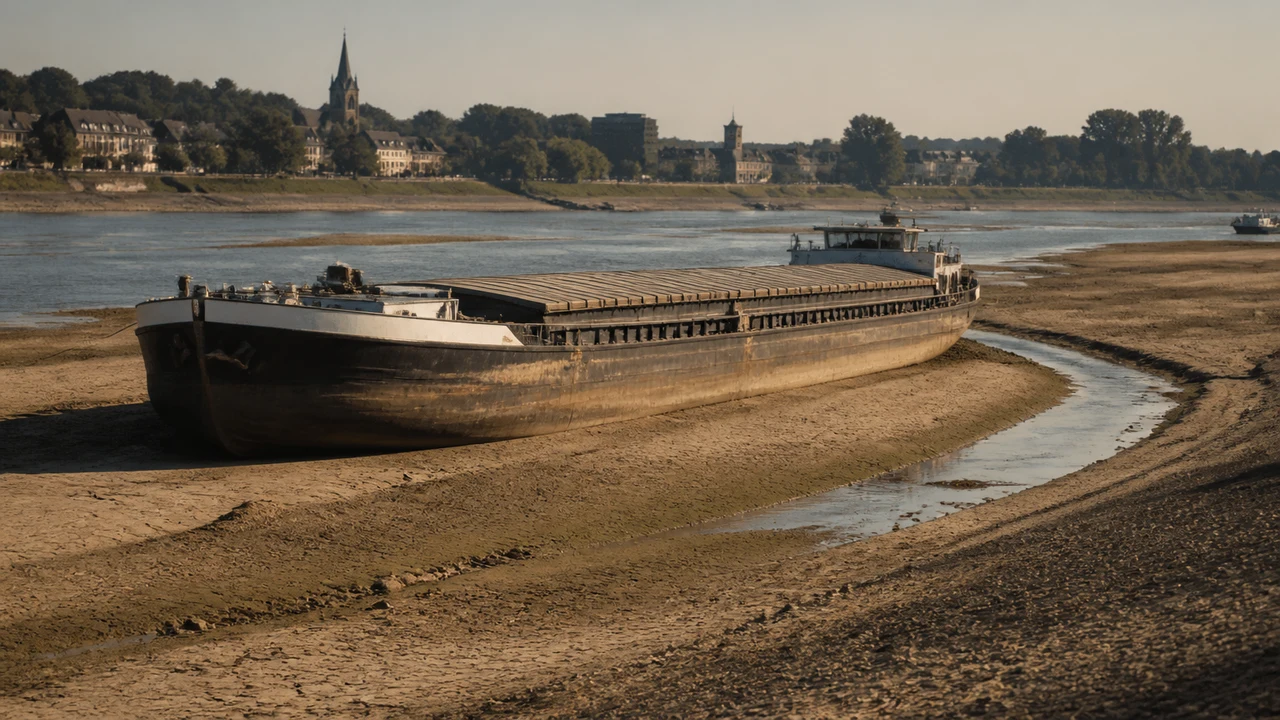
On 12 August, Germany’s waterways administration (WSV) recorded a navigable channel depth of 12 centimetres at Kaub — the key bottleneck between Mainz and Koblenz. The previous record was 25 cm back in 2018. At Düsseldorf, the water level dropped to 14–15 cm, the lowest since measurements began in 1880.
In practice, barges are sailing with roughly one fifth of their usual cargo. Freight on the Rotterdam–Karlsruhe route jumped from €45 to €155 per tonne — more than triple. Cargo that cannot move on the river shifts to rail and road, and capacity there runs short immediately.
The Panama Canal: every half-centimetre of draft costs money
Gatun Lake levels are falling again, and the canal authority is cutting the permitted draft in two steps: 48 feet from 26 August (14.63 m), and 47.5 feet from 3 September (14.48 m) until further notice.
A vessel simply cannot load full. The consequences are immediate: a transit slot at auction averaged around $1.1 million in August, and carriers are adding surcharges — from 19 August MSC applies a Panama Canal surcharge of $100 per TEU on routes from Asia to the US East Coast and Gulf ports.
Why this reaches the Baltics too
Panama and the Rhine may look far from Riga. But the freight market is a single organism, and it evens itself out:
- Insurance. War risk premiums rise for the whole region, not just for one vessel.
- Surcharges. BAF, war risk surcharge, canal fees — they appear in the rate regardless of where your cargo actually is.
- Detours. Every extra day at sea is fuel and wages, and it reduces fleet turnover — less available tonnage means higher rates for everyone.
- Empty container flow. When ships sail slower and lighter, empty containers return to Europe later. That is exactly what hits container availability and prices at Baltic depots fastest.
Put simply: risk at sea never stays at sea. It turns into fuel, insurance and days in transit — and eventually settles quietly into the final price of a container. Nobody itemises it on the invoice.
What to do in practice
For buyers. If you need a container in the autumn, it is worth fixing the price now. History shows a simple pattern: when freight rises, new-build container factory prices follow with a lag of a few months, while the used market reacts even faster — simply because Europe temporarily runs short of available containers.
For renters. Longer contracts currently beat short ones — a supplier finds it easier to hold the price when utilisation is guaranteed.
For everyone. Plan delivery times with a buffer. If the Panama Canal or the Rhine is anywhere in your chain, standard transit times will not hold this autumn.